
 Tiếng Việt
Why Does Supercritical CO₂ Extraction Preserve More Natural Compounds and Aroma?
In the essential oil industry, product quality depends not only on the quality of the raw materials but also on the extraction technology used. For agarwood, the value of its essential oil lies in the hundreds of naturally occurring aromatic compounds that create its rich, complex, and distinctive fragrance. If these compounds are degraded or lost during extraction, the quality and authenticity of the essential oil can be significantly affected. This is one of the key reasons why Supercritical CO₂ Extraction has become increasingly recognized as one of the most advanced extraction technologies. By operating under relatively low temperatures and high pressure, this method helps preserve delicate natural compounds that are highly sensitive to heat.
1. What Creates the Unique Aroma of Agarwood?
Unlike many essential oils that are dominated by only a few major compounds, agarwood possesses an exceptionally complex aroma profile.
Natural agarwood contains hundreds of chemical constituents, including:
- Sesquiterpenes
- 2-(2-Phenylethyl) Chromones (unique marker compounds of agarwood)
- Volatile aromatic compounds
- Various naturally occurring bioactive compounds
The interaction of these compounds creates the deep, multi-layered fragrance that makes natural agarwood one of the world’s most valuable aromatic materials.
2. What Happens During High-Temperature Extraction?
Many of agarwood’s aromatic compounds are highly sensitive to heat.
When raw materials are exposed to elevated temperatures for extended periods, several changes may occur:
- Some volatile compounds may evaporate and be lost.
- Certain aromatic molecules may degrade or undergo chemical transformation.
- The natural balance among different compound groups may change.
- The final aroma may differ from that of the original raw material.
This does not mean that steam distillation produces low-quality essential oil. However, depending on the raw material and processing conditions, prolonged heating can influence the composition of the final extract.
3. Why Can Supercritical CO₂ Preserve More Natural Compounds?
3.1 Low-Temperature Extraction
One of the greatest advantages of Supercritical CO₂ Extraction is that it operates at relatively low temperatures, typically between 31°C and 60°C.
Compared with traditional steam distillation, these milder conditions greatly reduce the risk of thermal degradation and help preserve heat-sensitive aromatic compounds.
3.2 Reduced Oxidation
Extended heating can promote oxidation of certain natural compounds when exposed to oxygen.
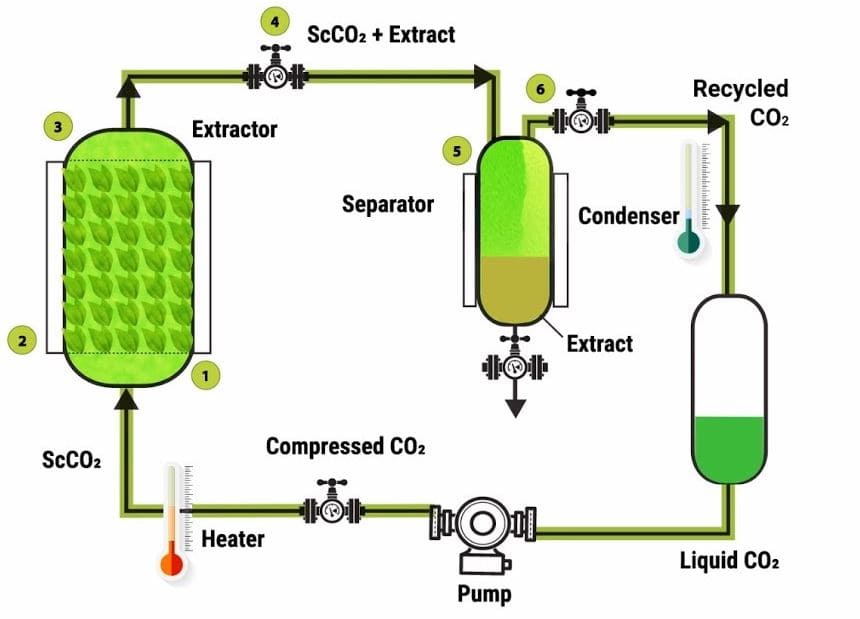
Supercritical CO₂ Extraction takes place inside a sealed, high-pressure system, minimizing oxygen exposure throughout the process.
This controlled environment helps reduce oxidation and better maintain the integrity of the extracted compounds.
3.3 Adjustable Solvent Properties
One of the most remarkable characteristics of supercritical CO₂ is that its solvent strength can be precisely adjusted by controlling pressure and temperature.
This allows manufacturers to selectively target specific groups of desirable compounds rather than extracting only those that readily evaporate with steam.
The result is a more flexible and highly optimized extraction process.
3.4 More Selective Extraction
Not every compound within agarwood contributes equally to its quality and value.
By fine-tuning extraction parameters, Supercritical CO₂ technology enables more selective extraction of valuable aromatic and bioactive compounds while minimizing unnecessary components.
This contributes to improved product consistency and higher-quality extracts.
4. How Does This Improve Agarwood Essential Oil Quality?
Preserving a broader range of natural compounds provides several important advantages:
- Aroma that more closely resembles natural agarwood.
- A richer and more complex chemical profile.
- Greater consistency between production batches.
- Premium-quality extracts suitable for luxury applications.
- Higher value for perfumery, cosmetics, aromatherapy, and natural wellness industries.
For these reasons, Supercritical CO₂ Extraction has become the preferred technology for manufacturers producing premium botanical extracts.
5. Does Supercritical CO₂ Preserve Every Natural Compound?
No extraction technology can preserve 100% of all naturally occurring compounds.
Extraction efficiency depends on many factors, including:
- Quality of the agarwood raw material
- Degree of resin formation
- Particle size
- Extraction pressure
- Extraction temperature
- Processing time
- Extraction system design
However, numerous scientific studies and industrial applications have demonstrated that Supercritical CO₂ Extraction is capable of preserving and recovering a broader range of natural compounds than many conventional extraction methods, particularly those that are sensitive to heat.
6. Next Article
Now that we understand why Supercritical CO₂ Extraction preserves natural compounds more effectively, the next important question is:
👉 Why Is Supercritical CO₂-Extracted Agarwood Essential Oil Superior for Perfumery, Cosmetics, and Pharmaceutical Applications?
In the next article, AGARVINA will introduce the major aromatic compounds found in agarwood essential oil and explain their contribution to fragrance quality, commercial value, and applications in perfumery, cosmetics, aromatherapy, and wellness products.
7. Frequently Asked Questions (FAQ)
7.1 Does Lower Extraction Temperature Always Mean Better Essential Oil Quality?
Not necessarily.
Extraction temperature is an important factor, but the final quality also depends on raw material quality, extraction parameters, and equipment performance.
7.2 Does Supercritical CO₂ Extraction Change the Natural Aroma of Agarwood?
The primary objective of Supercritical CO₂ Extraction is to preserve as much of the original natural aroma as possible.
However, the final aroma profile also depends on factors such as agarwood species, resin quality, tree age, and extraction conditions.
7.3 Why Is CO₂ Considered a Green Solvent?
Carbon dioxide leaves no solvent residue in the final product after depressurization.
Additionally, the CO₂ used during extraction is continuously recovered and recycled, reducing waste and minimizing environmental impact.
7.4 Is Supercritical CO₂ Extraction Suitable for Premium Products?
Yes.
Because it produces highly pure extracts while preserving delicate natural compounds without solvent residues, Supercritical CO₂ Extraction is widely used in the production of premium ingredients for fragrances, cosmetics, aromatherapy, nutraceuticals, and luxury wellness products.
8. About AGARVINA
AGARVINA is one of Vietnam’s pioneering companies specializing in the production of agarwood essential oil using Supercritical CO₂ Extraction technology.
The company is also a pioneer in applying microbial inoculation technology to naturally induce agarwood formation in Aquilaria trees. This innovative biotechnology has been officially recognized by the National Office of Intellectual Property of Vietnam, which granted AGARVINA a Utility Solution Patent.
With more than 1,100 hectares of sustainably managed agarwood plantations, over 2 million Aquilaria trees, and a team of experienced scientists, engineers, and skilled craftsmen, AGARVINA has built a fully integrated value chain—from sustainable plantation management and natural agarwood induction to advanced CO₂ extraction and manufacturing.
By combining large-scale raw material resources, proprietary biotechnology, and Supercritical CO₂ Extraction, AGARVINA is committed to supplying premium-quality agarwood ingredients and becoming a trusted global partner for the fragrance, cosmetics, aromatherapy, and natural wellness industries.
VIETNAM AGARWOOD PRODUCTION COMPANY LIMITED
- Office & Showroom: No. 3, Street 45, An Khanh Ward, Ho Chi Minh City, Vietnam.
- Hotline: 1900 9279
- Phone/Zalo: (+84)964 898 849 – Mrs. Tiên
- Email: agarvina@gmail.com
- Shopee Mall: https://shopee.vn/agarvina
- LazMall: https://s.lazada.vn/s.2ruMo
- Youtube: https://www.youtube.com/@agarvinavn
Bài viết cùng chủ đề:
-
How Is the Global Market for CO₂-Extracted Agarwood Essential Oil Evolving?
-

Ưu điểm vượt trội của công nghệ chiết xuất tinh dầu Trầm Hương bằng CO₂ siêu tới hạn: Lợi ích và thách thức
-

Why Is Supercritical CO₂-Extracted Agarwood Essential Oil Superior for Perfumery, Cosmetics, and Pharmaceutical Applications?
-
Supercritical CO₂ Extraction vs. Steam Distillation: What Are the Differences?
-

What Is Supercritical CO₂ Extraction? An Advanced Technology for Agarwood Essential Oil Production
-

Experience a Home Spa with Agarwood Oil/OUD
-
Why Do Agarwood Chips Hold Significance in Feng Shui?
-
5 Reasons Why Agarwood Incense Is Popular In Meditation
-
Agarwood Tea And Its Fascinating Connection To Feng Shui
-
Common Mistakes When Using Agarwood Cone Incense
-
Common Mistakes When Using Agarwood Incense Sticks
-
How To Clean And Preserve Natural Agarwood Powder
-
How To Clean and Preserve Pure Agarwood Chips: Maintaining Nature’s Value
-
Pure Agarwood Incense And The Serenity In Yoga
-
Applications Of Agarwood Tea In Cuisine
-
Agarwood Oil/OUD And How To Create A Clean Space


Vui lòng trả lời câu hỏi sau: Bốn + ba bằng mấy?