
 Tiếng Việt
Supercritical CO₂ Extraction vs. Steam Distillation: What Are the Differences?
In the essential oil industry, steam distillation has been the most widely used extraction method for centuries due to its relatively simple process, proven reliability, and lower investment costs. In contrast, Supercritical CO₂ Extraction is an advanced technology developed to meet the growing demand for higher purity, better preservation of natural compounds, and premium-quality botanical extracts. So, how do these two extraction methods differ? Which one is better suited for producing high-quality agarwood essential oil? This article provides a comprehensive comparison to help manufacturers, buyers, and consumers better understand the strengths and limitations of each technology.
1. Overview of the Two Extraction Methods
1.1 Steam Distillation
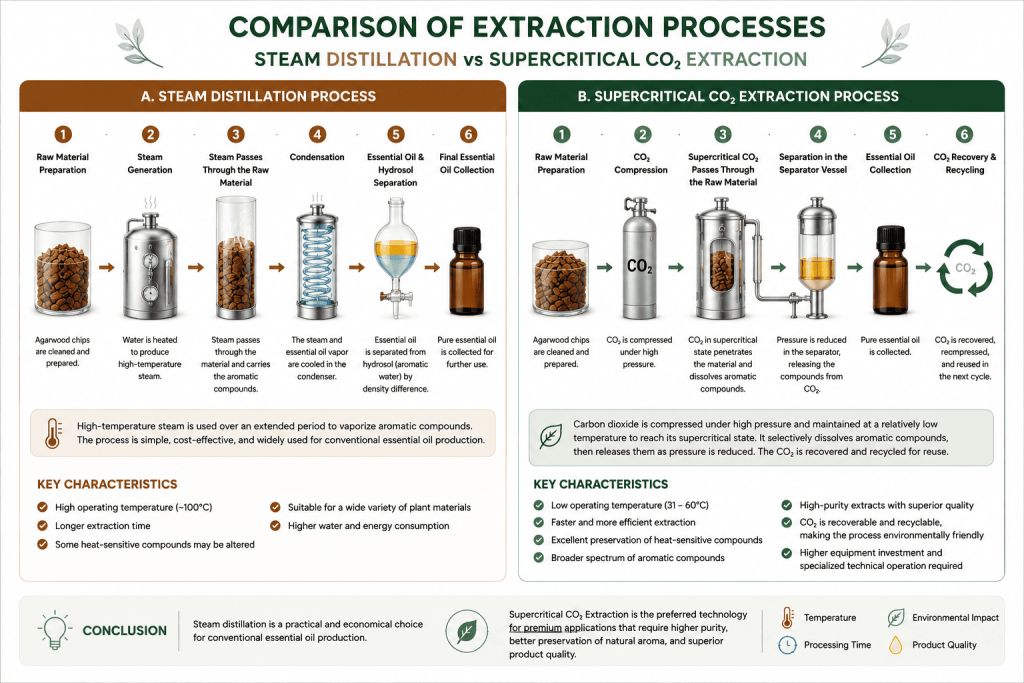
Steam distillation uses high-temperature steam to vaporize volatile aromatic compounds from botanical materials.
The steam carrying the essential oil passes through a condenser, where it cools into a liquid mixture of water and essential oil. Because oil and water have different densities, the essential oil is then separated.
This traditional extraction method is widely used for producing essential oils from plants such as lemongrass, lavender, eucalyptus, cinnamon, and agarwood.
1.2 Supercritical CO₂ Extraction
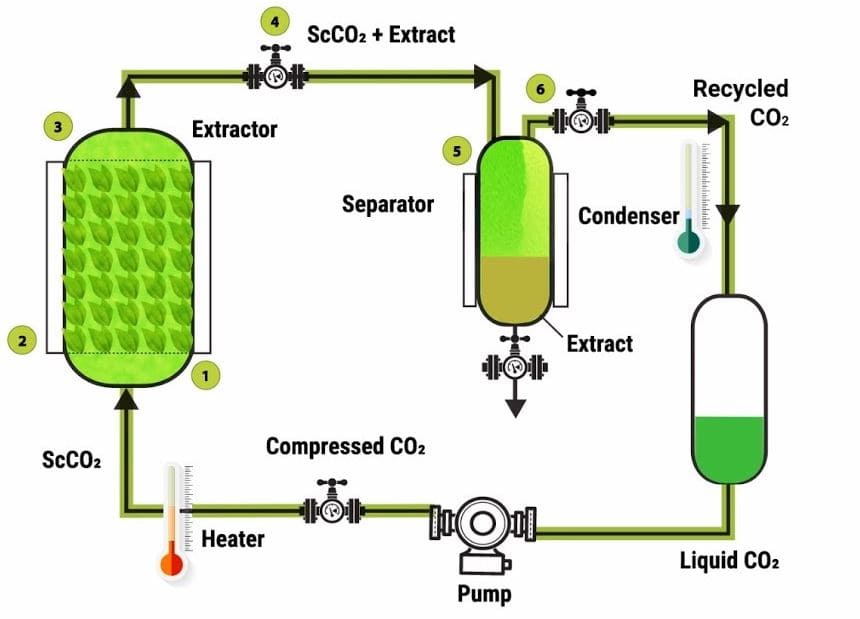
Instead of using steam and high temperatures, Supercritical CO₂ Extraction employs carbon dioxide compressed under high pressure and heated slightly above its critical temperature.
In this unique state, CO₂ behaves as both a gas and a liquid, allowing it to dissolve aromatic compounds and carry them out of the raw material.
After extraction, the pressure is reduced, causing CO₂ to return to its gaseous state and separate naturally from the extract. The CO₂ is then recovered and reused within the closed-loop system.
2. Supercritical CO₂ Extraction vs. Steam Distillation: A Detailed Comparison
2.1 Extraction Principle
Steam Distillation
- Uses steam to vaporize volatile aromatic compounds.
- The vapor is condensed and separated into water and essential oil.
Supercritical CO₂ Extraction
- Uses carbon dioxide in its supercritical state.
- Dissolves aromatic compounds without boiling the raw material.
- Pressure reduction separates the extract from CO₂, which can then be recycled.
2.2 Extraction Temperature
One of the most significant differences lies in the extraction temperature.
Steam distillation requires continuous heat to generate steam and extract volatile compounds.
Supercritical CO₂ Extraction operates at temperatures only slightly above the critical point of CO₂ (approximately 31.1°C) while using high pressure.
Because of these relatively mild temperatures, many heat-sensitive compounds are better preserved throughout the extraction process.
2.3 Preservation of Natural Aroma
The distinctive fragrance of agarwood comes from a complex combination of aromatic compounds.
Some of these compounds are sensitive to prolonged exposure to heat.
Since Supercritical CO₂ Extraction does not require boiling the raw material, it generally preserves a broader range of natural aromatic molecules, resulting in an extract that more closely resembles the original aroma of agarwood.
2.4 Range of Extracted Compounds
Steam distillation primarily captures volatile compounds that can evaporate with steam.
By contrast, Supercritical CO₂ Extraction can recover a wider spectrum of aromatic and bioactive compounds, depending on the selected pressure and temperature conditions.
This flexibility allows manufacturers to optimize the extract for different industrial applications.
2.5 Product Purity
Supercritical CO₂ Extraction does not require organic solvents.
Once the extraction process is complete, CO₂ naturally returns to its gaseous form and separates completely from the extract.
As a result, the final product contains no solvent residues, making it highly suitable for premium fragrance, cosmetic, and wellness applications.
2.6 Environmental Impact
Steam distillation consumes considerable amounts of water and thermal energy to generate steam.
Supercritical CO₂ systems operate in a closed-loop process that continuously recycles carbon dioxide.
This significantly reduces waste while supporting environmentally responsible and sustainable manufacturing.
2.7 Investment Cost
The two technologies differ considerably in terms of capital investment.
Steam Distillation
- Lower equipment cost
- Simple operation
- Easier maintenance
Supercritical CO₂ Extraction
- Advanced extraction equipment
- Higher initial investment
- Requires specialized engineering expertise and high-pressure operation
However, for manufacturers targeting premium markets and international exports, the higher investment is often justified by superior product quality and increased commercial value.
3. Overall Comparison Table
| Criteria | Steam Distillation | Supercritical CO₂ Extraction |
|---|---|---|
| Extraction Principle | Steam carries volatile compounds | Supercritical CO₂ dissolves aromatic compounds |
| Operating Temperature | High | Low |
| Organic Solvents | No | No |
| Preservation of Heat-Sensitive Compounds | Moderate | Excellent |
| Range of Extracted Compounds | Mainly volatile compounds | Broader spectrum of aromatic compounds |
| Product Purity | High | Very High |
| Solvent Recovery | Not Applicable | CO₂ is recovered and recycled |
| Investment Cost | Low | High |
| Automation Level | Moderate | High |
| Best Application | Mass production | Premium products & export markets |
4. Which Extraction Method Should You Choose?
Neither technology is universally better for every application.
Steam distillation remains an excellent choice for large-scale production where lower equipment costs and operational simplicity are priorities.
On the other hand, manufacturers seeking premium-quality extracts, superior aroma preservation, broader compound recovery, and compliance with international quality standards often prefer Supercritical CO₂ Extraction.
Ultimately, the ideal extraction method depends on product positioning, target markets, and long-term business objectives.
5. Frequently Asked Questions (FAQ)
5.1 Does Supercritical CO₂ Extraction Use Chemical Solvents?
No.
Supercritical CO₂ Extraction does not require organic solvents such as hexane, ethanol, or acetone.
Carbon dioxide functions as the extraction medium and completely evaporates after pressure reduction, leaving no solvent residues in the final extract.
5.2 Is CO₂-Extracted Agarwood Oil Pure Essential Oil?
CO₂ extracts are highly pure and preserve a broader range of naturally occurring compounds.
Because their composition may differ slightly from steam-distilled essential oils, many international manufacturers refer to these products as CO₂ Extracts rather than conventional essential oils.
5.3 Why Does CO₂ Better Preserve Natural Aroma?
The extraction process occurs at relatively low temperatures.
This minimizes thermal degradation and oxidation, helping retain delicate aromatic compounds that contribute to the authentic fragrance profile of agarwood.
5.4 Is Supercritical CO₂ Extraction Environmentally Friendly?
Yes.
Most Supercritical CO₂ extraction systems operate as closed-loop systems where carbon dioxide is continuously recovered and reused.
Combined with the absence of organic solvents, this makes the technology one of the most environmentally sustainable extraction methods available today.
5.5 Can Supercritical CO₂ Completely Replace Steam Distillation?
Not necessarily.
Each technology serves different production goals.
Steam distillation remains practical and cost-effective for many essential oils, while Supercritical CO₂ Extraction is generally preferred for premium botanical extracts requiring superior quality and higher market value.
5.6 What Are the Main Applications of CO₂-Extracted Agarwood Oil?
Supercritical CO₂ agarwood extracts are widely used in:
- Fine fragrance and perfumery
- Luxury cosmetics
- Aromatherapy
- Natural wellness products
- Premium incense ingredients
- Botanical research and product development
6. About AGARVINA
AGARVINA is one of Vietnam’s pioneering companies specializing in the production of agarwood essential oil using Supercritical CO₂ Extraction technology.
The company is also a pioneer in applying microbial inoculation technology to naturally induce agarwood formation in Aquilaria trees. This innovative solution has been officially recognized by the National Office of Intellectual Property of Vietnam through the granting of a Utility Solution Patent.
With more than 1,100 hectares of sustainably managed agarwood plantations, over 2 million Aquilaria trees, and a team of experienced scientists, engineers, and skilled craftsmen, AGARVINA has established a fully integrated value chain—from plantation development and agarwood induction to advanced extraction and manufacturing.
By combining sustainable raw material resources, proprietary biotechnology, and Supercritical CO₂ Extraction, AGARVINA is committed to delivering premium-quality agarwood ingredients and becoming a trusted global partner for the fragrance, cosmetics, wellness, and natural products industries.
VIETNAM AGARWOOD PRODUCTION COMPANY LIMITED
- Office & Showroom: No. 3, Street 45, An Khanh Ward, Ho Chi Minh City, Vietnam.
- Hotline: 1900 9279
- Phone/Zalo: (+84)964 898 849 – Mrs. Tiên
- Email: agarvina@gmail.com
- Shopee Mall: https://shopee.vn/agarvina
- LazMall: https://s.lazada.vn/s.2ruMo
- Youtube: https://www.youtube.com/@agarvinavn
Bài viết cùng chủ đề:
-

How Is the Global Market for CO₂-Extracted Agarwood Essential Oil Evolving?
-
Ưu điểm vượt trội của công nghệ chiết xuất tinh dầu Trầm Hương bằng CO₂ siêu tới hạn: Lợi ích và thách thức
-

Why Is Supercritical CO₂-Extracted Agarwood Essential Oil Superior for Perfumery, Cosmetics, and Pharmaceutical Applications?
-

Why Does Supercritical CO₂ Extraction Preserve More Natural Compounds and Aroma?
-

What Is Supercritical CO₂ Extraction? An Advanced Technology for Agarwood Essential Oil Production
-

Experience a Home Spa with Agarwood Oil/OUD
-
Why Do Agarwood Chips Hold Significance in Feng Shui?
-
5 Reasons Why Agarwood Incense Is Popular In Meditation
-
Agarwood Tea And Its Fascinating Connection To Feng Shui
-
Common Mistakes When Using Agarwood Cone Incense
-
Common Mistakes When Using Agarwood Incense Sticks
-
How To Clean And Preserve Natural Agarwood Powder
-
How To Clean and Preserve Pure Agarwood Chips: Maintaining Nature’s Value
-
Pure Agarwood Incense And The Serenity In Yoga
-
Applications Of Agarwood Tea In Cuisine
-
Agarwood Oil/OUD And How To Create A Clean Space


Vui lòng trả lời câu hỏi sau: Bốn + ba bằng mấy?